DeFi fixed income has reached a new milestone.
For the first time, an on-chain fixed-rate borrowing market is being anchored to a transparent benchmark rate.
Curated by KPK, the new ETH markets on Euler set their borrowing rate each cycle using the Treehouse Ethereum Staking Rate (TESR), Treehouse’s on-chain benchmark for Ethereum staking yields under the Decentralized Offered Rates (DOR) framework.
This marks an important step forward for DeFi fixed income: moving from purely variable-rate markets toward benchmark-driven primitives that are transparent, predictable, and accessible on-chain.
DeFi’s First Fixed-Rate Market, Powered by TESR
Now live on Euler, the tETH/WETH and wstETH/WETH markets let users deposit tETH or wstETH as collateral and borrow WETH at a fixed rate for the duration of each monthly cycle.
Once a cycle begins, the borrow rate is anchored and locked to the TESR 30-day consensus.
There are no mid-cycle rate changes, no sudden repricing, and no unexpected shifts in borrowing rates during the term. At the end of each cycle, the market references the latest TESR reading before setting the rate for the next cycle.
This creates a more predictable borrowing experience for users who want to manage leverage, duration, and yield strategies without being exposed to constant variable-rate movements.
Borrow WETH at a fixed rate on Euler using tETH or wstETH as collateral.
Why Fixed Rates Matter
Most DeFi lending markets today are variable-rate by design.
While variable rates work for flexible borrowing, they introduce uncertainty. Borrowers cannot reliably forecast their cost of capital. A sudden rate spike can compress returns, disrupt strategies, or erase the expected profit from an entire cycle.
This is one of the biggest missing pieces in DeFi credit markets.
In traditional finance, fixed income markets are built around rate benchmarks. These benchmarks give lenders, borrowers, institutions, and structured products a common reference point for pricing capital across different durations.
DeFi has historically lacked this foundation.
Without credible, transparent, and widely usable benchmark rates:
- Fixed-rate markets have struggled to scale
- Liquidity has remained fragmented
- Pricing has been difficult to standardize
- Many fixed-rate products have remained short-lived
The TESR-anchored Euler market offers a new path forward.
What is TESR?
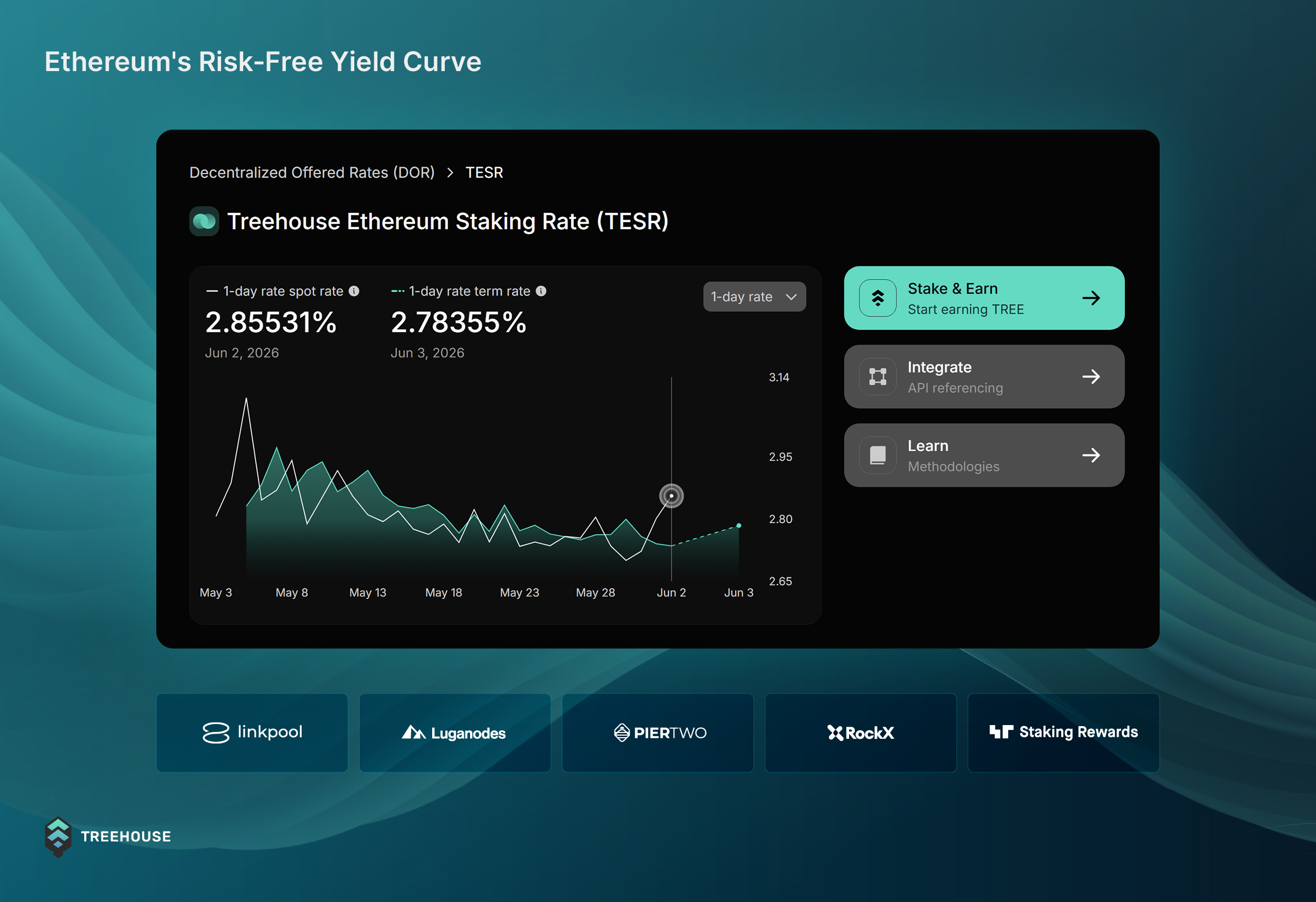
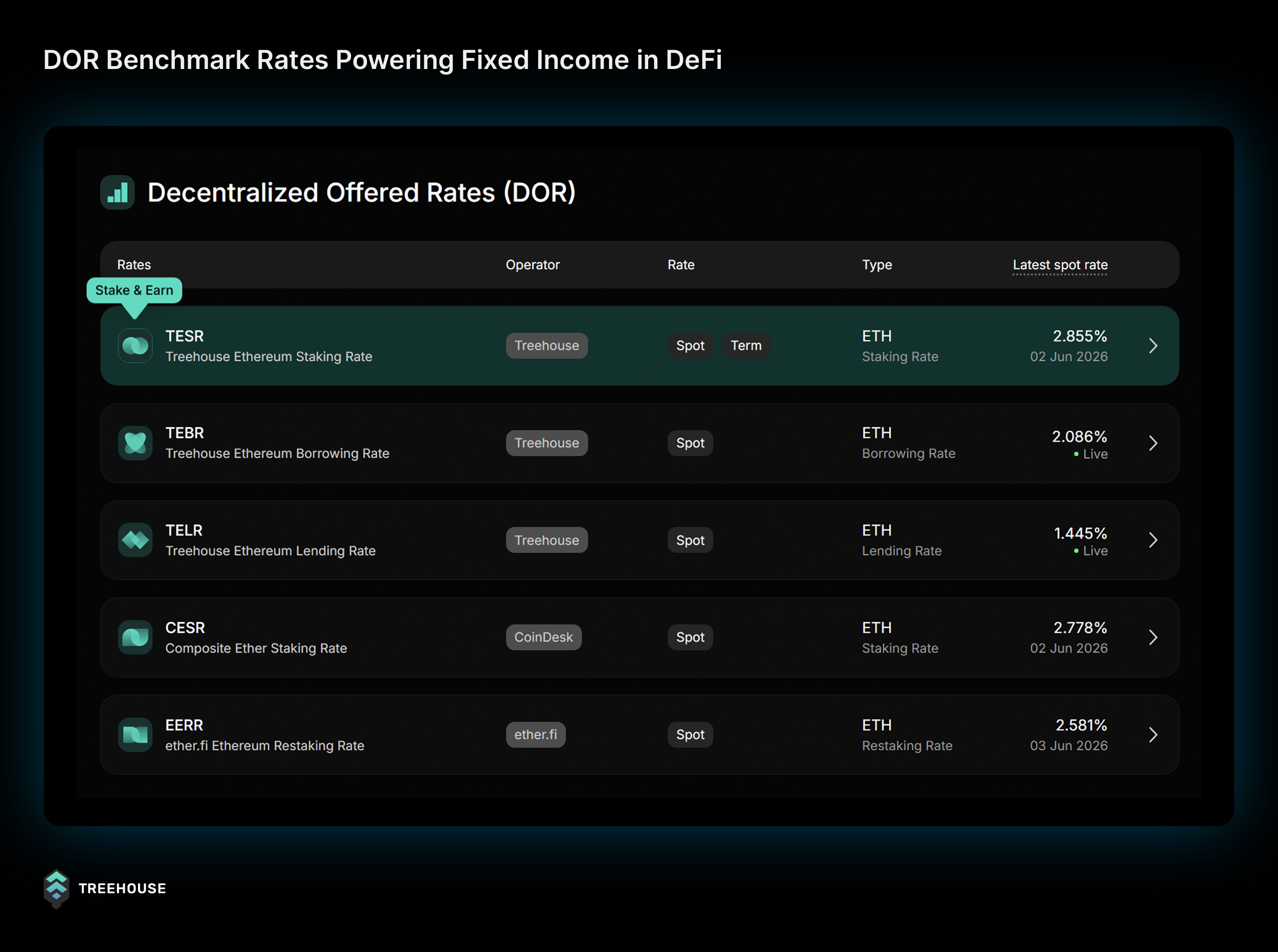
TESR, or the Treehouse Ethereum Staking Rate, is the first benchmark under Treehouse’s Decentralized Offered Rates (DOR) framework.
TESR is designed to serve as a transparent reference rate for Ethereum staking yields. Under the DOR consensus-based framework, institutional panelists submit daily 30-day forward forecasts for ETH staking yields. These submissions form a consensus benchmark rate that is transparent, auditable, and resistant to manipulation.
By anchoring fixed-rate markets to TESR, DeFi protocols can price products against a rate that reflects forward-looking expectations for ETH staking yields, rather than relying solely on market utilization or isolated liquidity conditions.
This allows fixed-rate markets to become more standardized, more composable, and more aligned with the way mature credit markets operate.
View the Treehouse Ethereum Staking Rate (TESR) here.
Curated by KPK
The market is curated by KPK, one of DeFi’s leading vault curators.
KPK curates vaults across Morpho, Euler, and Gearbox, bringing institutional-grade risk frameworks and structured collateral management to DeFi lending. Their role here extends that same discipline to ETH credit on Euler.
Through its ETH Yield Term vault, KPK supplies WETH liquidity into the Euler market, enabling borrowers to access fixed-rate capital backed by tETH or wstETH collateral.
The decision to build this market around TESR reflects a broader shift in DeFi. Fixed income products need credible benchmarks, professional curation, and transparent infrastructure in order to scale.
From Institutional Desks to Public DeFi Markets
TESR has already begun gaining adoption beyond Treehouse.
Through FalconX, the first TESR-referenced institutional ETH staking rate forwards was launched in September 2025, bringing benchmark-based fixed-income products to institutional trading desks.
Now, that same benchmark powers an open on-chain market accessible to anyone through Euler.
TESR is moving from institutional use cases into public DeFi infrastructure, demonstrating how DOR benchmarks can support both professional counterparties and permissionless markets.
Why This Matters for DeFi
Every mature credit market depends on credible benchmark rates.
Traditional finance has used benchmarks such as LIBOR, SOFR, treasury curves, and other reference rates to price loans, derivatives, swaps, bonds, and structured credit products. These benchmarks create a shared foundation for capital markets by giving participants a common reference point.
DeFi has not had an equivalent foundation.
Most on-chain lending markets are still driven by variable utilization curves. While powerful, these models are not enough to support the full development of fixed income markets. To build more advanced credit products, DeFi needs benchmark rates that are transparent, resilient, and composable.
By bringing benchmark rates on-chain, DOR enables protocols, curators, market makers, and institutions to build financial products that can reference standardized rates directly within DeFi.
The Euler market enabled by TESR is an early example of what that infrastructure can unlock.
Building the Fixed Income Layer of Digital Assets
Treehouse is building the fixed income layer of digital assets.
That vision requires more than yield products. It requires benchmark infrastructure that markets can trust and build on top of.
With TESR now powering a fixed-rate borrowing market on Euler, DeFi has taken a step closer to the kind of benchmark-driven market structure that underpins traditional fixed income.
DeFi has never had a fixed-rate borrowing market anchored to a credible, backtested, and transparent on-chain benchmark.
Until now. 🌳
Frequently Asked Questions (FAQs)
Q: What collateral does the market accept?
A: tETH and wstETH.
Q: What asset can I borrow?
A: WETH.
Q: How is the borrow rate set?
A: At the start of each cycle, the rate is derived from the TESR 30-D consensus published on-chain by DOR. The formula bounds the borrow rate to a 2.05–2.50% APY band, keeping the rate predictable and within a defined range every cycle.
Q: How long is each cycle?
A: Each cycle runs for the length of the calendar month. The fixed borrow rate applies for all but the final day. On the last day, the borrow rate rises to 50% to incentivize repayment before the cycle closes.
Q: What happens at the end of a cycle?
A: A fresh TESR 30-D reading is pulled from DOR. The rate resets, and a new cycle begins
Q: What is the repayment window?
A: The final day of each cycle. The borrow rate rises to 50% during this window to incentivize timely repayment before the next cycle begins. This does not force liquidations. Users are recommended to repay before this date to avoid the elevated rate.
Q: What happens if I don’t repay during the repayment window?
A: If repayment is not made before the cycle closes, the position rolls into the next cycle automatically. The borrow rate refreshes to the new TESR 30-D rate for the upcoming month.
About Treehouse 🌳
Treehouse, a digital assets infrastructure firm and the decentralized arm of the parent company Treehouse Labs, is at the forefront of revolutionizing the decentralized fixed income market. Treehouse Protocol introduces innovative fixed income products and primitives across chains through tAssets, liquid staking tokens that empowers its users to participate in the convergence of on-chain interest rates while retaining the flexibility to engage in DeFi activities.
Treehouse Protocol is also pioneering the Decentralized Offered Rates (DOR) consensus mechanism for benchmark rate setting, enabling a range of fixed income products and primitives into digital assets. Treehouse is dedicated to creating safer and more predictable return alternatives for both individual investors and institutions.
Website: https://treehouse.finance
Discord: https://discord.gg/treehousefi